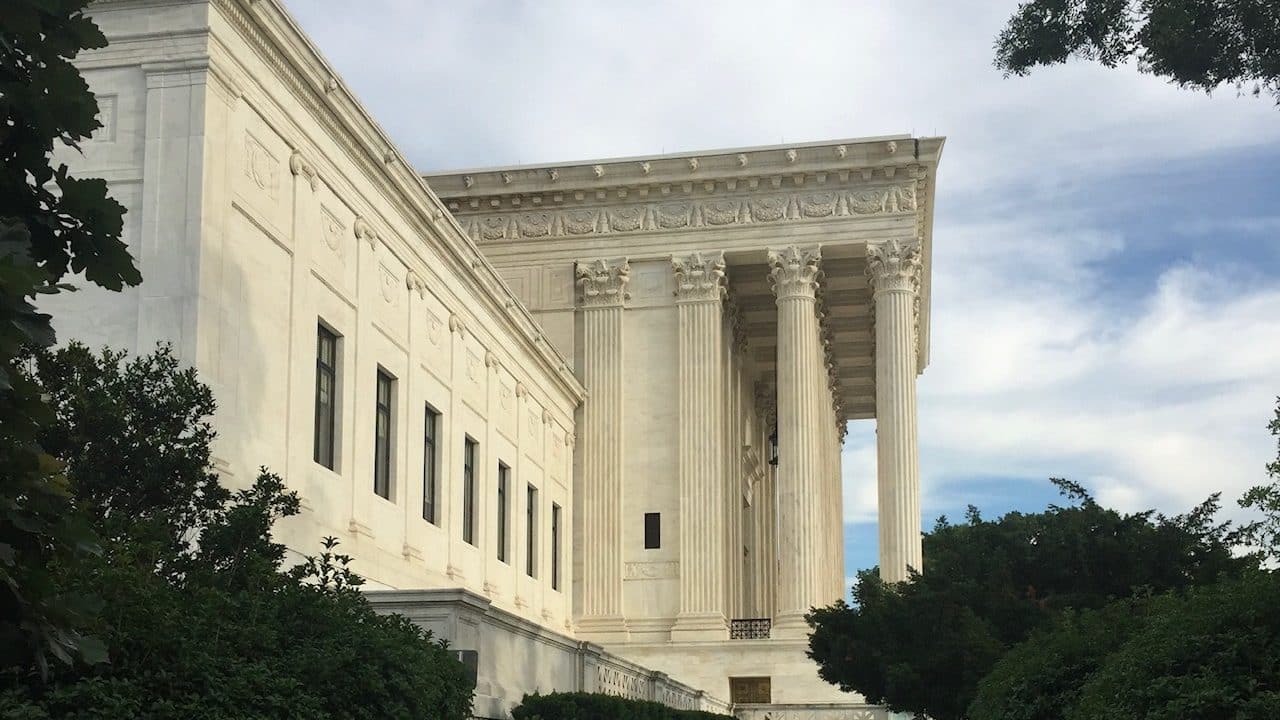
SCOTUS is currently in its “summer recess,” but summer recess for the Court does not mean no work is progressing. In fact, the High Court has had an unusually busy docket for this time of year. Last Thursday (Aug. 22), the Court issued a critically important order in an election case out of Arizona that everyone needs to pay close attention to.
Arizona is one of several states that has been valiantly clashing with the federal government (and federal courts) over election integrity (at least its legislature has). Among other blatant actions that weaken the integrity of the vote, the federal government refuses to permit states to require documentary proof of citizenship when an applicant registers to vote. In response, some key states have been leveraging state power to secure their elections.
The Background
Some time ago, Arizona made a brilliant move. It successfully instituted a bifurcated voter registration program. In Arizona, if you register to vote using the federal form (which, by law, the state cannot beef up with a request for documentary proof of citizenship), you may vote in federal elections only. To vote in state elections, you must register using Arizona’s state form, which does require documentary proof. This system has been the subject of a lot of litigation. A lawsuit initiated by the League of United Latin American Citizens resulted in a consent decree in 2018: If an applicant uses the state form and fails to provide documentary proof, Arizona must still register those applicants for federal elections (the “LULAC consent decree”).
In 2022, the legislature passed two new laws that sought to further secure the vote. The legislature revisited the subject of the LULAC consent decree and established that when an applicant registers to vote using the state form and fails to provide the required documentary poof of citizenship, rather than registering that person for federal elections, the state rejects the application outright. The new voting laws also prohibit voters who have not provided documentary proof of citizenship from casting ballots for president or by mail. Ariz. Rev. Stat. §§16-121.01(E), 16-127(A).
This Case
The inevitable lawsuits ensued. The district court “ruled on partial summary judgment motions in September 2023, holding that the [National Voter Registration Act] preempted the provisions relating to presidential electors and mail-in voting, and that Arizona must continue processing non-compliant state form registrations in accordance with the LULAC Consent Decree.” It appears that the district court might have dragged its feet a little in issuing an appealable injunction. Although the defendants pushed for an appealable order, the court only issued it in May 2024.
The defendants sought a stay of the injunction at the Ninth Circuit, that is to say, they asked the Supreme Court to permit Arizona to enforce the disputed provisions of the law while litigation is ongoing. They received conflicting decisions from two separate panels, which brought them to the Supreme Court, asking the highest court to grant the stay.
Thursday’s SCOTUS Order
SCOTUS agreed only as to the first provision, so, while litigation is ongoing, Arizona should reject outright applicants who use the state form and do not provide proof of citizenship. The Court left in place the other two provisions, which means Arizona voters who fail to provide proof of citizenship will still be able to vote for president and vote by mail.
This was an application to stay an injunction, not a petition for writ of certiorari (i.e., merits appeal). But, when considering an application of this nature, the Court considers factors that can provide insight into the final outcome. Those factors are that there is “(1) a reasonable probability that four Justices will consider the issue sufficiently meritorious to grant certiorari; (2) a fair prospect that a majority of the Court will vote to reverse the judgment below; and (3) a likelihood that irreparable harm will result from the denial of a stay.” Hollingsworth v. Perry, 558 U.S. 183, 190 (2010) (per curiam).
Which Way Did Each Justice Vote?
Justices Thomas, Alito, and Gorsuch would have granted the application in full—that is to say, they would have lifted the injunction on all three provisions of the law, but they did not have a fourth vote for the second two. Either Chief Justice John Roberts or Justice Kavanaugh must have joined those three on the proof-of-citizenship provision only, but we do not know which Justice. Justices Sotomayor, Kagan, Barrett, and Jackson would have denied the application in full. Yes, you read that right; Amy Barrett would have denied the entire application. So the Chief and Justice Kavanaugh are mystery cards. One of them joined his conservative colleagues and lifted the injunction on the proof-of-citizenship requirement. But neither was willing to join on the other two provisions, which is why they failed.
All three provisions can still proceed to SCOTUS on the full merits, if the defendants file a petition for a writ of certiorari, which I expect will happen in due course.
The Political Take-Away
It is important to note that the Republicans in the Arizona legislature and the RNC are defending this law. Arizona’s Attorney General Kris Mayes asked SCOTUS not to lift the injunction, because it would be destabilizing to enforce so close to the election.
The two provisions for which SCOTUS refused to grant a stay are obviously very important to this 2024 election. Failure to permit Arizona to enforce those safeguards is a real disgrace.
Nevertheless, the Arizona legislature is making important constitutional law about the separation of powers and state versus federal power. This is critical for our liberty in the long run. The only hope we have of saving this country lies in successfully resisting the exploding centralization of power in the federal government. When it comes to voting, in particular, it is essential that we decentralize to defend the integrity of the vote. This case merits close attention from all freedom-loving Americans.
Leave a Reply